Category: essays

  • ebb and flow

    A year ago around this time I wrote a little summary of my life so far.  I posted it on my tumblr account, which I have since deleted.  I’d like to write about my previous year at Seattle Pacific and my hopes for next year.  This is a little exposition.


    He woke up for the first time, covered in goop, and opened his eyes to bravely examine his surroundings.  “This will certainly do.”  He gave his thanks to the white-clad women and men surrounding him, took the hands of the people who brought him and walked out of the building with them to breath the cool air and climb into the yellow automobile awaiting the newcomer.

    “It really is great of you to take me in like this,” he told the people in the front seat.  The woman looked back, gave the kind of smile where her eyes didn’t, and proclaimed, “He’s trying to talk!”

    “Trying?” the little person hazarded his first question.  In response the woman just laughed and grabbed his left foot between her forefinger and thumb and shook it gently.  “Your sister will love you!” she said after a minute of this.

    “This is going to be a long childhood,” the baby groaned inwardly.  He began to cry.

    But it wasn’t a long childhood at all.  Before he could grasp the concept of a year, several had passed.  He could not only walk, but bounce and run and hop.  His parents, sister, and most other people could now understand his speech.  Music would float into his room on many days, and it was through music that he learned how to use his ears.  He listened, and — when ready — grabbed a few notes and tried them on.  They fit awkwardly, like the clothes his sister shoved him into sometimes and giggled so much at.

    When he began to feel like he had a grasp on how to go about doing things, his world widened.  His parents, who he had trusted up to this point, brought him to an unfamiliar woman in an unfamiliar building and left him there.  He felt betrayed.

    “This is going to be a terrible way to spend my time,” the toddler thought bitterly.  He began to cry.

    But he realized this new place wasn’t as terrible as he thought it would be.  The others, for there were other small people who found themselves in the same place, they all seemed to be generally decent playmates.  He played and laughed with them for years, but also listened whenever the tall woman felt like saying something.  He counted, he read, he wrote.  But in the end he always went home to be with his parents and sister, who he discovered had already learned whatever he had.  Sometimes his sister poked fun at him, but she also helped him understand whatever happened.  He learned how to clumsily make music with an instrument instead of his voice.  His favorite thing was when his dad patiently played along.

    When he began to feel at peace with these new rhythms, the song changed.  His house rejected his family, and he had to cut off the friendships he spent years building and prepare to find new ones.  His parents told him they were going on a grand adventure to a land surrounded by water, but he didn’t really care for this plan.  The choice wasn’t his.  So he packed everything up like the rest of them and got into the red van, which was awaiting the long voyage.

    “Life is going to end,” the kid thought with the melodramatic certainty that can come easily to a small person facing a large change.  He began to cry, but felt stupid for it.

    Of course, life continued after the three-day journey.  Their home had followed them in the move, even if it did take them some time to unpack it.  There was a new building here where he went to learn new things and build new friendships.  The music also followed them, so he used it to plug into new places.  He realized that his parents had known all along that he would like it there.  He shifted around and became comfortable and happy.

    Time kindly slowed down so he could take his time living in it.  He matured a bit in this new home and began to grapple with faith.  He loved the church they attended and spent a good deal of time there.  It welcomed them as if they were family.

    The years began to feel cyclical.   Music, laughter, family, church, sadness, love, school, all of them swirled him around in an intricate dance.   He learned from the rhythms of time and attempted to prepare himself for the next inevitable change.  He packed his bags calmly to let himself know that he could.  He said ‘goodbye’ to the big building and the teachers in it.  ‘Goodbye’ to his church.  ‘Goodbye’ to his friends.  ‘Goodbye’ to his home.

    He woke up.  The day had come.  The only thing he was scared of was his own sense of readiness.  He hugged and thanked his parents, sent a kiss to his sister who had moved out before him, let a tear fall, and bravely boarded the grey plane that was awaiting him.

    “This is going to be—“ the young man began.  But he thought better of it and decided to let time speak for itself.

    01
  • consider the chipmunks

    When I first learned to drive I felt as if I had grown wings.  I flew down the roads of rural and suburban Western Michigan like a gas powered Icarus, always approaching—but never reaching—freedom.  The little Toyota Corolla  has always felt safest on the more scenic routes.  Take it to the highway and it starts to shudder.  Sometimes it makes me wonder if my wings could just fly off while I’m driving, leaving me naked and embarrassed on the interstate.

    I first experienced speed-freedom a couple of weeks into learning how to ride a bike.  The first weeks I experienced more pavement than anything else, but once I became comfortable on the seat, I rode up and down the street in front of our home in Manchester, New Hampshire.  When my parents were satisfied that I could pedal around safely enough, I biked around the block for the first time.  “Around the block” really meant down the sidewalk, take a right, take another right and go until you reach the dead end—the house of my best friend.  From there I could bike across his lawn into our back lawn, around our gardens and swingset, and then arrive back home.  Even with my newfound freedom, home was always the final destination.
    (more…)

  • fresh abloom

    The bedroom I left in late December of this past year was grey.  In a reactionist swerve away from the key lime pie green of middle school, Dad and I covered the walls with an adult ashen grey—the shade of embers found in the heart of a fire that is just beginning to die.  With my new wall-mounted bookshelves and IKEA furniture, it looked like the bedroom of someone who wants a PhD in something eventually.  I really liked it, so the room stayed like that throughout high school.

    But there was little color or light.  The only window in the room faced away from the sun.  It opened out underneath the deck.  After reading Jonathan Safran Foer and listening to an art prof who said “Forms and colors can speak directly to human emotion.  Does this red square speak to you?  Any hands?” I began to see how color can speak to my spirit and alter the emotions I have about present life as well as memories of the past.

    Going to school in Seattle, I became well aware of how color, or rather, the lack of color can compound my depression, something I have quietly dealt with since middle school.  For me, depression is greyness: being void of emotion.  And if there are emotions, they are sadness and self-loathing.  They occasionally leave me numb.  And there I was, standing on a hill in Seattle, surrounded by grey clouds.  It could feel like the earth was reaching to dip me into those clouds and swirl me in them like a stick of lint-flavored cotton candy.

    (more…)

  • picture day

    Walking down the hallway had never felt as victorious as it did on school picture day in second grade.  Per usual, I was rockin the pinkish chipmunk cheeks and hair waxed into what the barber lady called the Macauley Culkin (back when that was a compliment).  My mom had taken me to a thrift store across the street from my first violin teacher in downtown Manchester to search for suitable attire.  I girded myself with the spoils of our hunt for that school picture—a tailored Italian khaki suit.  Mrs. White said I looked like a little business man.  I wasn’t exactly sure what a businessman was, but I figured they at least looked good.

    The rest of my elementary school pictures didn’t quite live up to the standard I set in second grade.  I peaked early.  Around third or fourth grade—it depends on the person—many children lose their ability to be cute without any effort.  Maybe this wasn’t your experience, but third grade was the year I first snatched the packet of school portraits from my teacher’s hand, glanced at them once, and slammed them on the desk with the little plastic window facing down.  Besides perhaps one or two kids who always looked good (or felt so strongly that they always looked good that the rest of us believed them) most of the class did the same with their pictures.  Some of the girls would let out a small sob and/or mutter something about retake day—an occurrence that became the first meaningful experience of redemption for many of us.  The guys would either simply flip the pictures over like me or take them out, laugh, and show their friends.  After seeing a few pictures from the latter group, most of us realized that we all looked a little ridiculous and felt better about ourselves.  Trade with a friend, pass it around, laugh a little, stop laughing, grab the picture back, place it back on the desk face down until the bell rang.  And, of course, sign up for retakes.

    (more…)

  • bleeding ink

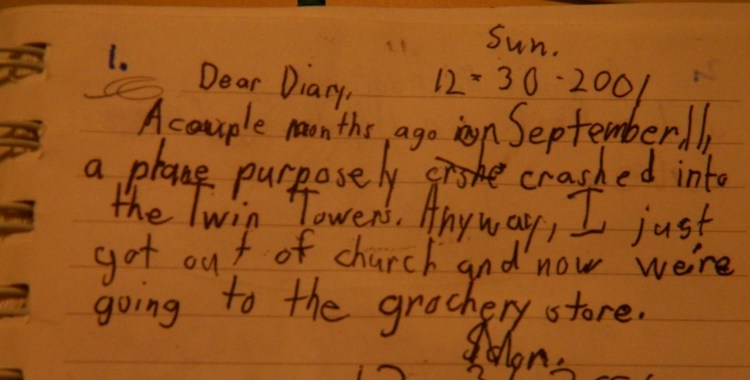
    I began my first journal on December 30, 2001.  It is spiral bound, but the spiral is covered by paper that joins the front and back covers of the journal, which has an old map of the world printed on it.  The designers chopped a square out of the front cover, leaving a window to the first page, on which a sailboat is floating under the early morning moon.  I remember loving this journal and having no clue what to write in it.  The first entry:

    journal 1

    (more…)

  • what is it all about?

    Love.

    I’ve been playing some weddings recently, Christian ones.  Depending on who you are and what the service is like, Christian weddings can either be intensely beautiful or oppressive.  The wedding I played yesterday was beautiful.  A sister of a friend of mine was the bride, and the service was more of a worship service than anything else.  I played with a cellist, pianist, and percussionist on a cajón, all very talented musicians and very fun to play with.  The music was featured fairly prominently throughout the wedding, but the focus wasn’t on us as it sometimes is.  We played hymns and newer worship songs that were important to the bride and groom.  I felt freer as a musician because technical perfection was not the goal.  At the heart of the service was two people and their families and friends saying “thank you” for the gift of love in their lives.

    The part that can be oppressive for some people is the language of submission.  You are probably familiar with the passage from Ephesians 5:  “Wives, submit to your husbands, as to the Lord.  For the husband is the head of the wife as Christ is the head of the church, his body, and is himself its Savior.”  Paul continues to challenge husbands to love their wives as Christ sacrificially loves the church.  I’m not an expert by any means, but it seems both charges are very difficult.  The overall theme of the passage is the profound love at the center of marriage.  It demands self-sacrifice of husband and wife, which appears to me to be submission in itself.

    (more…)

  • on doing good

    Jobs.  It’s all about the jobs.  Gotta have one.

    I really loved my first year at Seattle Pacific University, and the idea of going home and getting a job was offensive—not like the racist relative with whom you spend your holidays, but like the black beans you left in the fridge for too long, which now rot.  Laziness is really what it was.  My inner child sat on his chair in the corner screaming when he realized his summer would need to have some structure and—horror of horrors—productivity.

    Reason won out, as it sometimes does.  But what should I do?  Barrista?  Hmmm!  Teach violin?  Yes, but that isn’t full time.  Physical labor?  Nobody would pay me for that.  Write a bunch and make a living off of submissions to literary journals?

    Not easy, as it turns out.

    (more…)